|
A 3rd century fortress with swallow-tail crenelation; Giovanna II of Angiò stayed here. A recently restored fortified military
complex in defence of a village. It represented
 the westernmost outpost of the Ascoli state in defence of the Tronto river, and a bastion of defence of the borders with Umbrian lands, which
over time were revindicated from Ascoli domination. Its beginnings can probably be traced to the 11th century, with the moment of
maximum expansion occuring in the mid 15th century under Queen Giovanna II of Naples; modifications were made over time to reach
the result visible today. Built from arenaceous stone, the double retaining walls are well preserved, as are a polygonal corner
tower and a rectangular keep; both of these have a brick overhangs predisposed for the hurtling of objects in defence, and are
crowned with Ghibelline crenelations. The fortress is perched on a rocky spur just north of the inhabited area.
The first structure to have been built on the hill was most likely the the tower, on a hexagonal plan, about 12 meters
high and situated on the southeast corner.
the westernmost outpost of the Ascoli state in defence of the Tronto river, and a bastion of defence of the borders with Umbrian lands, which
over time were revindicated from Ascoli domination. Its beginnings can probably be traced to the 11th century, with the moment of
maximum expansion occuring in the mid 15th century under Queen Giovanna II of Naples; modifications were made over time to reach
the result visible today. Built from arenaceous stone, the double retaining walls are well preserved, as are a polygonal corner
tower and a rectangular keep; both of these have a brick overhangs predisposed for the hurtling of objects in defence, and are
crowned with Ghibelline crenelations. The fortress is perched on a rocky spur just north of the inhabited area.
The first structure to have been built on the hill was most likely the the tower, on a hexagonal plan, about 12 meters
high and situated on the southeast corner.
In order to assure a more efficient defensive structure, between the 14th and the
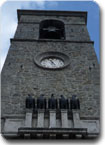
15th centuries the northern tower was built on a square base of 7 x 7 meters to height of 24m. The tower, the most imposing
element of the fortification, faced south to converge with the hexagonal tower by means of a double wall delimiting a large
rectangular internal space of 21 x 24m. Within this space there would have existed several constructions, allowing dozens of
people to live inside for months at a time. The last structure of the fortress to have been built is a round tower 10m in
diameter and 12m high, tamped with soil and with a wide terrace containing pieces of artillery at the level of the crenelations.
Today only some of the foundations of this round tower remain. 1996 saw the restoration of all the walls of the castle including
the retaining wall, and the completion of a multi purpose hall inside the large courtyard.
|