

NORCIA
BASILICA AND CRYPT OF SAN BENEDETTO
|
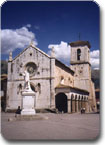
The Romanesque-gothic church of S. Benedetto was erected between
1290 and 1338 on an earlier crypt from the 11th century. The bell tower dates back to the 14th century, b
ut was destroyed by earthquake in 1730 and reduced to a smaller size. The cottage-type façade is laterally
delimited by two pillar-shaped pilasters, and is divided in two by a cornice: on the lower part there is a
lovely doorway with bands of slender columns that border a lunette, ornamented with a sculpted group; on
the sides there are two corner shrines and the statues of SS. Benedetto and Scolastica. On the higher
part there is a restored rose window. In 1570 the adjoining arcade of Misure was built. It was used
as a covered market selling grains and cereals; some of the stone containers used for measuring are still
visible. The interior has a single nave and an 18th century imprint. Restorations in the 1950s uncovered
a 14th century triumphal arch, residual from the gothic construction. The apse preserves a wooden crucifix
from the 1500s, and the altar of the right transept has a 17th century painting on canvas by V. Manenti.
A stairway in the middle of the nave descends into the crypt, which is divided into three little naves.
The larger central nave has a lowered gothic vault, and the lateral naves have ship-type vaults, although
they are not original. The nave on the left is closed by a small apse with frescoes from the 14th century,
that were part of a Roman building from the 1st century a. C., later transformed into the first oratory
S. Benedetto. According to tradition it is the birth place of the Saint and his sister S. Scolastica.
A gated door leads to the archaeological area. The ex-monastery of S. Benedetto of 1115 with a 1541
dooway by Francesco da Milano is adjacent to the church.
|
CATHEDRAL OF SANTA MARIA ARGENTEA
|
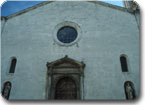
Standing on the site of an ancient pagan temple from the 3rd century a. C.,
in the high medieval it had the title of pievechurch. The church was destroyed in 1554 for the building of the
Castellina and then rebuilt nearby between 1560 and 1574. Today’s building is the result of rebuilding over
the years due to the damage from earthquakes. The simple façade is delimited by lateral pilasters and doorway
topped by a tympanum and a circular window. The lateral wall has a gothic doorway belonging to an older pieveand
re-adapted to the new church, which dates from from the end of the 14th century. The bell tower was damaged
from several earthquakes and in 1869 the present day tower was erected. The bell tower has a stone base with
an entryway, a second section above it and the bell chamber has four large gothic arches. The interior of the
church has three naves and shows evidence of remodelling work done in the 1960s. The 17th century chapel of
the Misericordia has a 1520 tryptic attributed to F. Sparapane, the painter of other frescoes in the chapel
dated to 1528. Near the altar at eh entrance there is a painting on canvas Pomarancio from the early 1600s.
|
CHURCH AND ORATORY OF SANT'AGOSTINUCCIO
|
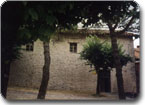
Ex-oratory fo the Brotherhood of the Cinturati, dependants of the Augustines,
and standing on the site of the ancient church of S. Apollinare. It has a richly decorated gilded and painted
lacunar ceiling and an altar with a large 15th century Crucifix flanked by paintings on canvas from the 1600s.
|
CHURCH OF DI SAN FRANCESCO
|
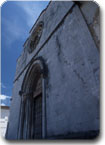
The convent Minori settled inside the Norcia walls in 1265, and subsequently built the present day church of S. Francesco, where they lived until 1809. The building is the result of a gothic style reconstruction in 1385. It was restored in 1859 after earthquakes had caused its partial colllapse. It has a rectangular plan and a single apse. The facade and the left side is banded by two cornices on false floors, given the difference in the height of the entrance way and the side doorway. The lateral doorway has a slightly acute arch and alternating smooth and slender corded columns. The main doorway is richly decorated; the capitals of the columns have floral and anthropomorphic motifs. The lunette has a fresco from the 1400s. The interior has a single nave and preserves a few of the once plentiful wall murals: one of S. Antonio da Padova and G. Battista di Giovannofrio of 1501 and one of S. Francesco of Crivellesco influence.
|
CHURCH OF SANT'AGOSTINO
|
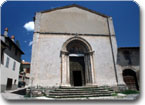
Erected in 1134 and enlarged in the 14th century, taking on a gothic style.
The simple façade has a notable doorway with a ogive lunette frescoed in 1388
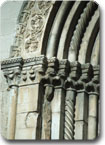 with the figure of the Virgin Mary placet between S. Agostino and S. Nicola da Tolentino. The columns, capitals
and arched lintels of the door are decorated with floral and anthropomorphic motifs. It has a single nave with
a trussed ceiling; in the 1600s several wooden altars were erected; the presbytery was rebuilt in the 1700s.
Near the entrance way are several paintings from 1457-63 attributed to G. Sparapane. In right lateral niche
there are frescoes from 1502, possibly by Giacomo Giovannofrio, those on the opposite side are signed by brother
Giovan Battista (1497). On the left wall are also wall murals from 1541, by G. Angelucci of the Mevale school.
In small built-in wall wardrobe the remnants of painted decorations from 1442 are visibile, the work of various
artists, including Nicola da Siena.
with the figure of the Virgin Mary placet between S. Agostino and S. Nicola da Tolentino. The columns, capitals
and arched lintels of the door are decorated with floral and anthropomorphic motifs. It has a single nave with
a trussed ceiling; in the 1600s several wooden altars were erected; the presbytery was rebuilt in the 1700s.
Near the entrance way are several paintings from 1457-63 attributed to G. Sparapane. In right lateral niche
there are frescoes from 1502, possibly by Giacomo Giovannofrio, those on the opposite side are signed by brother
Giovan Battista (1497). On the left wall are also wall murals from 1541, by G. Angelucci of the Mevale school.
In small built-in wall wardrobe the remnants of painted decorations from 1442 are visibile, the work of various
artists, including Nicola da Siena.
|
CHURCH OF SAN GIOVANNI
|
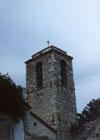
The origins of this church are unknown, although it is acknowledged to be of a very ancient tradition. Its present day shape is the result of rebuilding work done after the earthquake of 1703, but also of restorations carried out in 1482.
The baroque facade has a curvilinear upper section and is decorated by a stucco ornamented window. The lateral wall has a ogive doorway from the late 1300s, the only remnant of teh original building; on the left side stands the 14th century bell tower, which has undergone many modifications.
The interior has two naves of different sizes: the larger one has a wooden ceiling from the 1700s, the smaller has a modified sail vault and is closed by a 16th century stone altar.
Some devotional paintings by the Sparapane from 1466-68 are visible in the presbytery.
|
CHURCH OF MADONNA DI CASCIA
| E’ una chiesa rurale ubicata al limite delle Marcite,
costruita nel 1477 per la solenne pace stipulata tra Norcia e Cascia. Restaurata dopo il terremoto
del 1979, conserva all’interno un affresco del 15th century.
|
CHURCH AND CONVENT OF THE MADONNA BIANCA
|
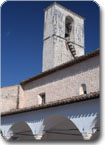
(FRAZIONE DI ANCARANO) Completed in 1508, it has been remodeled several
times due damages from earthquakes. The longer side opens onto an arcade with seven arches supported by 15th
century columns; the facade has a nartex that predates the 1500s with five fornix, the work of Lomabard
stonecutters. On the front stands a bell tower of the same period as the arcade. Under the vaults of the nartex
is a gothic style doorway (late 1400s) and to the side of this a shrine decorated with frescoes by one of the
Sparapane. The interior has two naves divided by four columns and three arches supporting the roof. The
presbytery is formed from two cross vaults and separated from a hall by a double staircase. On the right
wall several frescoes by A. Sparapane from 1476 are visibile and there are others above the side door from
a later date. In the right apse there is a stone shrine with a wooden tabernacle from 1511,on which is placed
the statue of the Madonna Bianca dating back to 1488.
|
CHURCH OF SAN SALVATORE
|
(FRAZIONE CAMPI)
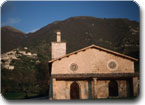
An important building from before 1115 with the title of Pieve di S. Maria and dependent on S. Eutizio.
In 1493 it was ceded to the monks of the “Campli” community, after which it took on the name of S. Salvatore.
The ancient Pievehad a single nave on the left side of the present day church and was enlarged in the 14th century.
This extension was still insufficient, so another temple on the right side was built with a second nave, communicant
with the first, a second rose window and a second doorway, causing it to become the prototype for all the other
churches of the area. An portico supported by a single column was erected against the facade. On the back of the
church, on the right side, stands the bell tower from the 16th century topped with a bell gable. The interior
has two naves divided into eight bays by five pillars supporting the arches of the ribbed cross vaults; the
vaults are extended over the whole area, excepting the front of the left nave, which is trussed. This is the
oldest part, and has a ogive arch that was frescoed in 1451. Past the arch there is a type of iconostasis, a
dividing structure that was reinforced by wood scaffolding after the earthquake, and the front surface is formed by three arches supported by octagonal columns. The lower parts of the body of the church were frescoed in
1493 by Giovanni and Antonio Sparapane. The lower area has paintings from 1466 by Nicola da Siena, one of
the Sparapane and Domenico da Leonessa. The back of the iconostasis also has paintings from the mid 1400s,
the work of several artists, including G. Sparapane; the large lunette shows the Crowning of the Virgin by A. Sparapane.
On the left wall, near the stairway that leads to the attic above the iconostasis, there are other fragments
of scenes by Nicola da Siena from 1460, including a Ultima Cena (Last Supper); in the cross gables are vaults
painted by A. Sparapane and the next bay has other paintings from 1429. In the area of the presbytery behind
the altar a crucifix from 1380 was recovered. The right nave is completely bare, except for a 1505 frescoed
niche by G. di Giovannofrio./span>
|
CHURCH OF SANTA MARIA DELLE GRAZIE-MADONNA DELLA NEVE
|
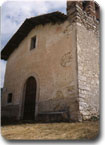
(frazione Campi) Standing on the high
part of the Castle, its origins predate the year 1630 inscribed on the architrave.
|
CHURCH OF SANT'ANDREA
|
(Frazione Campi)
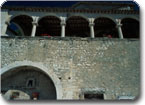
The pieve di the Campi Castle, built in the 1300s, and dependent on the Abbey of S. Eutizio,
 it took on the title of the “Plebale” of S. Salvatore in the 15th century. It has a loggia with
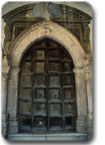
five arcades which were added later, whose vaults are decorated with frescoes. The doorway on the
left is the oldest; part of the original construction, it has two side columns that support two
culptures of lions on the capitals. The interior has two naves divided into three bays by pillars
that support the cross vault and it was redone in the 1500s. The high altar, dated 1590, has a
wooden display from 1596 and a painting on canvas of the Crucifixion. The church preserves other
wooden altars with a 1576 fresco of the Madonna del Rosario by one of the Carducci.
it took on the title of the “Plebale” of S. Salvatore in the 15th century. It has a loggia with
five arcades which were added later, whose vaults are decorated with frescoes. The doorway on the
left is the oldest; part of the original construction, it has two side columns that support two
culptures of lions on the capitals. The interior has two naves divided into three bays by pillars
that support the cross vault and it was redone in the 1500s. The high altar, dated 1590, has a
wooden display from 1596 and a painting on canvas of the Crucifixion. The church preserves other
wooden altars with a 1576 fresco of the Madonna del Rosario by one of the Carducci.
|
CHURCH OF SANTA MARIA IN PIAZZA
|
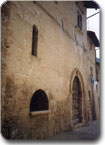
(Frazione Campi) Founded in 1351, 15th century records make
mention of it. In 1476 the building was improved. It has a 13th century ogive doorway that leads
to the first of three little naves with barrel vaults supported by six pillars. The wooden altar
dates back to 1649; it was here that the 15th century polyptych panels by G. Sparapane were placed;
they were later dismantled and are now located in the Museum of the Diocese of Spoleto. The vault of
the central nave illustrated a cycle of frescoed histories by the same Sparapane from the mid 1400s;
now only four episodes remain.
|
CHURCH OF SANT'ANTONIO
|
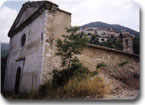
A low building with a small gabled bell tower and a sacristy in place of the apse.
It has a 16th century façade with a tympanum, oculus and white stone doorway. The interior has trussing supported
by pillars and preserves 15th century frescoes, and on the right a mural triptych by A. Sparapane from the beginning
of the 1400s.
|
CHURCH OF SANTA MARIA ASSUNTA
| (Frazione Castelluccio)
Located high in the old village, it has a 15th century structure that is still visibile, even though it has been
reworked over the years. The plaster façade has a stone doorway, flanked by a smaller door with a gothic
arch decorated with arched lintels and lateral pareses; the date 1528 is inscribed on the architrave.
Today’s bell tower substituted the original one 1801.
It has a central plan with four wings and an octagonal cupola.
The 17th century altar of the posterior wing is enriched by a wooden Crucifix from the 15th century and a
17th century painting on canvas. The right wing has a 1540 stone altar by Francesco da Milano; In the 1990s
frescoes of the Madonna del Rosario by C. e F. Angelucci (1582) were discovered and a partially damaged 1499
polychrome wooden Virgin Mary with Child (Madonna col Bambino) by Giovannantonio di Giordano da Norcia
is also visible.
|
CHURCH AND CONVENT OF THE MADONNA DI MONTESANTO
| (FRAZIONE SAN PELLEGRINO) Built in 1309 and entrusted
to the Clareni monks who lived there until the 1500s. In 1517 the Osservanti (Observants)
entered, followed by the Riformisti (Reformers) in 1610. Up until 1910 the convent also had
an archive and library. The structure was reinforced externally by robust arches and it has
a little gabled bell tower and a frescoed door (17th century). The church contains some
paintings on canvas from the 1600s and a little wooden statue of the Virgin Mary and Child
from the 14th century. The sacristy leads to the cloister with wall arches.
|
Copyright © 2007 Parco Nazionale dei Monti Sibillini
Tutti i diritti riservati - All rights reserved
Revised -- 20/08/2007
URL:
http://www.sibillini.net/en/il_parco/cultura_territorio/edifici_di_culto/norcia.php