

 |
|
 |
THE APENNINE CHAMOIS
Superordine: Ungulati (Ungulata)
Ordine: Artiodattili (Artiodactyla)
Famiglia: Bovidi (Bovidae)
Sottofamiglia: Caprine (Caprinae)
Sottospecie italiana: Camoscio appenninico (Rupycapra pyrenaica ornata Newman, 1899)
|
 |
Thanks to a well-constucted
project the apennine chamois has returned to the Monti Sibilini. This is a great accomplishment for
the preservation of the species. In 1996 the apennine chamois was put on the UICN red list of mammals in danger of extinction,
and in 1992 was included in the European Union Habitat directives.
SIZE
The length ranges from 110 to 130 cm, and the weight of adult males can reach 45 Kg, females between 30
and 35 Kg. Between 100 and 300 Kg
APPEARANCE (morphology)
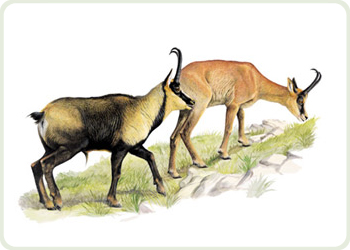
The extraordinary color of its coat has earned the apennine chamois the title of the “world’s
most beautiful chamois”. The coat is light brown in the summer, and darker in the winter, with white patches on its head, throat, neck, shoulders,
and hindquarters. A black stripe runs from the shoulders to the hooves. The horns can be longer than 30 cm, and curve up and outwards to then curve
back at the tips. The horns, present in both sexes, grow from year to year and form something like the rings in tree trunks, which can indicate the
age of the animal. The hooves are particularly adapted to adhere to rocks, the preferred environment of the chamois. The hooves are split, and can
even open up to form a 90° angle, to increase surface area and adherance.
HABITAT
Prefers areas over 1700 m of altitude, at the higher margins of beechwoods, where it can find bushes and rocky
slopes on which moves with extraordinary agility and strength, making spectacular leaps.
DIET
The diet is almost exclusively made up of grasses that can be found in abundance in the mountain prairies during
the summer. In the winter, when snow covers the high pastures, the chamois comes down to valley in search of food.
REPRODUCTION
In males, sexual maturity is reached around eight years of age. The reproductive period occurs only once
a year between November and December. Females give birth to a single cub in the period between May and June, after a gestation that varies from 160
to 180 days. The mother continues to milkfeed her young until autumn, but the diet of the youngster is supplemented with grasses very early.
BEHAVIOURS
Females, fawns and one and two-year-olds live in a herd. Males, abandoned by the herd, form their own small
groups, made up of animals between 2 and 4 years of age who have not yet reached sexual maturity. Later on, males will begin to live solitary, only
joining the herd during the mating season. The right to mate with females and have a harem, is obtained only after fights for dominance, which sometimes
can be quite violent.
THE CHAMOIS RETURNS TO THE NATIONAL PARK OF THE MONTI SIBILLINI
In 25 September 2006 the operation to transfer of a group of Apennine Chamois (Rupicapra pyrenaica ornata) from the National Park of Abruzzo,
Lazio and Molise to the National Park of the Monti Sibillini began. The group taken from the Val di Rose will be transported via the helicopters of the State
Forest Guard of the Monte Bove meadows to the National Park of the Monti Sibillini. A second release is planned for 2007. The goal of the program is to guarantee
the preservation of the species. After the settling of new reproductive groups, beginning in the 1990s with the reintroduction in the National Park of the Maiella
and the National Park of Gran Sasso and Monti della Laga, the chamois is now making its return to the Monti Sibillini. The first two chamois from the National Park
of the Maiella were released in June into the specifically equipped Bolognola fauna area.
LEARN MORE
The project
The project (italian language), sponsored by Life-natura, has the principal goal of guaranteeing
the preservation and development of new apennine chamois groups on the massifs of the Maiella and Gran Sasso over a long period, increasing genetic variability
and maintaining a consistent number, and to reduce the risks tied to direct and indirect interactions with domesticated animals and human activity. Additionally,
the project aims to increase the territorial area of the species in the National Park of the Monti Sibillini by creating a new family group, so as to improve the
efficacy of the preservation measures that have already taken place.
Videos:
- the transfer of two animals to Bolognola (27 June 2006): download (2 Mb circa)
Articles from “Voices of the Park” (italian language)
Press Releases (italian language)
MEET THE CHAMOIS
Even
spotting a chamois can be quite difficult, considering its natural habitat.
Thanks to the Bolognola Fauna Area, learning to identify, observing and getting
to know the chamois has become easier.
Publications
Copyright © 2002-2007 Parco Nazionale dei Monti Sibillinii
Immagini concesse dal Ministero dell'ambiente e della tutela del territorio)
Tutti i diritti riservati - All rights reserved
Revised -- 17.05.2007
URL:
http://www.sibillini.net/en/il_parco/fauna/index.html