

 |
 |
Superordine: Ungulati (Ungulata) Ordine: Artiodattili (Artiodactyla) Famiglia: Cervidi (Cervidae)
Genere e specie: Cervus elaphus |
 |
|
|
|
Superordine: Ungulati (Ungulata) Ordine: Artiodattili (Artiodactyla) Famiglia: Cervidi (Cervidae)
Genere e specie: Cervus elaphus |
|
After almost 200 years, the deer has returned to the Monti Sibillini, thanks to the reintroduction project carried out by the Park. Several animals have been released in the wild, while others live in the “semi-wilderness” of the Fauna Center, in the Municipality of Castelsantangelo sul Nera.
SIZE
The male, much larger than the female, is between 185 – 210 cm long, with a height of 105 – 140 cm and a weight that
ranges from 100 – 300 Kg. The female is between 150 – 180 cm long, with a height of 95 – 110 cm and a weight that ranges from 70 – 130 Kg. Fawns weigh
between 7 - 13 Kg at birth.
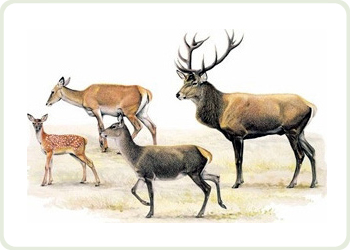
APPEARANCE (morphology)
VVaries according to sex and age. The muzzle, pointy up until the first year, tends to take on a
triangular shape, the slender neck tends thicken in males, and the mane becomes thicker as well. Only males have antlers (the “horns” of the cervidi). These
antlers are molted between February and March, and grow again, with each year seeing addtional branching. In fact it is possible to determine the age of the
animal from the size and complexity of branching on its antlers. The “cleaning” of the “velvet” covering the antlers takes place between July and September,
upon reaching mature development. The coat is reddish brown and lighter on the underside. After the autumn molting the fur darkens and takes on a grayisih
brown color. Fawns have a reddish fur with characteristc whitish spots.
HABITAT
The habitat is made up vast areas of coniferous or hardwood forests, punctuated by ample meadows. The woods are the
deer’s natural refuge, and when it moves to open areas, it prefers those that border the forest.
DIET
The strictly herbivorous deer has a fair capacity of adaptation, and changes its diet according to the seasons and the
availabilty of food. In autumn and winter it feeds on wild berries and dried grasses, and when these are insufficient, on tree bark. In the spring and
summer it feeds on various species of forage, buds, and wild fruit.
REPRODUCTION
Physiological sexual maturity is reached between the the first and second year, while psychological maturity
isn’t reached until seven and eight years for males, and from the third year on for females. Gestation is 226 – 236 days long and only one fawn, very
rarely two is born at a time. Births are concentrated in the months of May and June.
BEHAVIOUR
The lifespan of the deer in the wild is usually about 17-18 years. Deer live in a herds made up of females
and one-year-old males. Older males are solitary and quite territorial, while fawns older than one year, adolescents and mature deer form small groups.
During the mating season males join the female herd and loudly bell their characteristic mating call. In order to seduce a female and form a harem,
adult males of the same age often fight by butting eachother with their antlers. The higher the male’s position in the hierarchy, the greater the
number of females in his harem. When offspring are born, the herd divides to form family groups made up of the mother, one-year-old fawn, and newborn.
REINTRODUCTION OF THE DEER IN THE NATIONAL PARK OF THE MONTI SIBILLINI
The deer has returned to Monti Sibillini thanks to this reintroduction project. Between 2005 and 2006, 49 deer, 18 male and 31 female originally from the Demaniale Forest in Tarvasio have been released into the wild, in the area of the township of Castelsantangelo sul Nera. Zoologists using radiotracking have been able to carefully follow the movements and activities of the animals, who can be located by the signals emitted from their radio collars. Four animals have been released into the Fauna Center, where two fawns have already been born.
LEARN ABOUT THE DEER
Learn all about the deer and how to recognize one at the DEER ECO-MUSEUM, made up of a visitors center and fauna center.
The Visitors Center offers a trail through interesting “dioramas” that are finely made reconstructions of natural environments in different materials and taxidermic specimens (animals found dead which have been embalmed and stuffed). An imposing and noble male deer set upon a stage greets visitors as they enter. Other dioramas represent the most common environments and animals found in the Park: the beechwood in winter, the oak and maple forest in autumn, the rivers and springs, the Karstic plains and high summits. An acquarium with live amphibians and a model of the Monti Sibillini complete the displays, while informative panels and a great quantity of photographs offer information and sensations that can be directly relived in the Park environments. With the help of a multi-media exhibit one can travel back in time, a past evoked by stories and images of shepherds and elderly farmers from the high valleys of the Nera. One room has a running loop of nature images with a musical background playing, and another is an activity room just for children, where they can draw and paint “the Park as they see it”.
The Fauna Center, walking distance from the visitors center, is a large, fenced-in area (about 29 hectares) with feed troughs and obseravation towers. Deer in this area live in a condition of “semi-wilderness” and can maintain their habits and behaviours (inlcuding feeding and reproduction) very close to those in the wild. With the help of informative panels and watchtowers and above all qualified experts it is possible to observe and learn about the many different signs that indicate the age, gender and habits of this great hoofed animal, a real “Lord of the Forest”.
MORE INFORMATION
Videos:
- 1st release (5 March 2005): download (1,6 Mb circa)
- 2nd release (7 Aprile 2005): download (1,1 Mb circa)
- 3rd release (22 February 2006): download (2,6 Mbcirca)
low definition download (760 Kb) (760 Kb circa)
The Project (italian language)
Articles from “Voices of the Park” (italian language)
Publications (italian language)
Copyright © 2002-2007 Parco Nazionale dei Monti Sibillinii
Immagini concesse dal Ministero dell'ambiente e della tutela del territorio)
Tutti i diritti riservati - All rights reserved
Revised -- 17.05.2007
URL:
http://www.sibillini.net/en/il_parco/fauna/index.html