

 |
 |
Ordine: Carnivori (Carnivora) Famiglia: Canidi (Canidae) Sottospecie italiana: Canis lupus talicus |
 |
|
|
|
Ordine: Carnivori (Carnivora) Famiglia: Canidi (Canidae) Sottospecie italiana: Canis lupus talicus |
|
The wolf has long been considered the enemy of man. For this reason the wolf’s unjust persecution brought the species to the brink of distinction. At the end of the 1970s only a few animals were left in the Apennines, partly in the area of the Monti Sibillini. In the years that followed, thanks to the protection of the species, the number of wolves has increased substantially (an estimated 400-500 animals in Italy). Today the wolf is a stable presence all along the Apennine mountain chain and has also recolonized the Alpine area.
SIZE
The subspecies canis lupus italicus is markedly smaller than its Siberian
and North American counterparts: a typical male weighs about 35 Kg; the female 25 Kg. Body length ranges from
100 to 140 cm, not including the tail, and the height (in withers) ranges from 50 to 70 cm.
APPEARANCE (morphology)
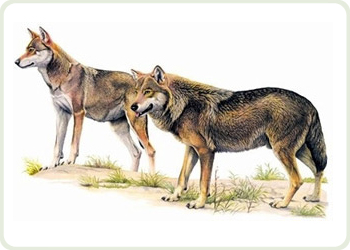
In appearance the wolf is quite similar to a German Shepherd,
however many characteristics distinguish it from the latter. It has short, pointy, erect ears and slanted yellow eyes.
Cubs have dark fur, while adults have a reddish-brown undercoat with hints of gray on the neck, back and above the ears.
The sides, shoulders and part of the muzzle are covered with a lighter gray fur.
HABITAT
The wolf is able to adapt to a range of different environments. It does however prefer the mountain environment
where it has the shelter of the hardwood forests and scrub-lands, in pristine wild territories far from the interfence of man.
DIET
Strictly carnivorous, with only an occaisonal consumption of fruit or vegetation for digestive or
depurative purposes. An adult wolf needs 1.5 – 3 Kg meat every day, but is able to fast for several days when there is a lack of prey.
Wolves tend to form packs and work together when hunting, especially in the case of large prey (deer, mountain goats, etc..).
The wolf does however feed on smaller types of prey such as hares, rodents and birds.
REPRODUCTION
Sexual maturity is reached in the second year. The mating season is in February and March. The gestation is two months;
females giving birth for the first time usually produce two or three pups, subsequent litters can be of 6 -7 cubs.
SOCIETY
The average life span of the wolf is 8 - 10 years. They live in
packs whose size is determined by the environment and available food sources. Where large prey are
available the packs can be quite large, but often in the Apennines the pack is made up of a single
family. The social structure is made up of two hierarchies: there is both a dominant male (alfa male)
and a dominant female (alfa female). The two sex-divided hierarchies are not interdependent , but are
characterized by a complex series of interactions of domination/submission in their respective hierarchies.
Cubs in their first year of life are inserted into only one hierarchy. Only the dominant couple in the pack
mates to produce offspring; in spite of this conflicts are rarely violent. These confrontations are characterized
by specific postures, behaviours and vocal emmissions through which contenders can judge what their possibility of
success would be in a direct conflict, and so are able to avoid it.
Copyright © 2002-2007 Parco Nazionale dei Monti Sibillinii
Immagini concesse dal Ministero dell'ambiente e della tutela del territorio)
Tutti i diritti riservati - All rights reserved
Revised -- 16.05.2007
URL:
http://www.sibillini.net/en/il_parco/fauna/index.html